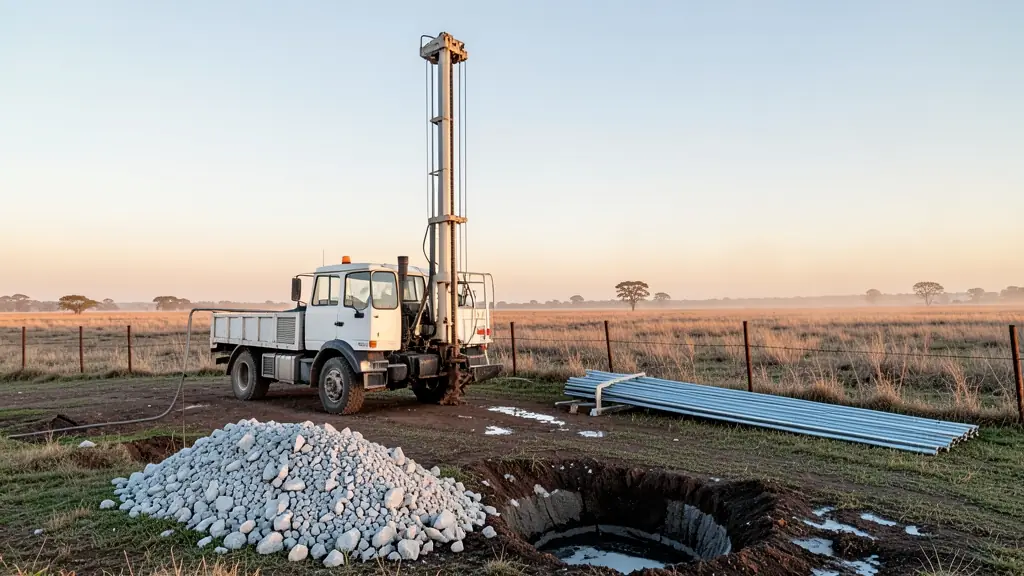
The drilling of a borehole is a gamble you can shorten the odds on, not remove. You pay for the survey, the metres drilled, the casing and the test whether the hole gives plenty or a trickle. Whether you want to drill a borehole on a Midrand plot, a Limpopo smallholding or a Karoo farm, the steps and the costs follow the same order, and knowing that order is how you read a driller's quote without surprises.
Price guideDrilling is quoted at about R290 to R750 a metre in most cities and up to R1,500 in hard ground, and a finished borehole often comes to about R30,000 to R150,000 depending on the city and depthA rough guide from published South African prices. The area, the term, the grade, what is included and VAT all move it.
The steps, in the order the driller does them
- Siting survey: a geohydrologist walks the property, often with a resistivity or magnetic survey, and marks one or two points where water bearing fractures are most likely.
- Drilling: most domestic holes are drilled with an air percussion rig that hammers through rock; rotary rigs grind through softer ground and deep sand.
- Casing: steel or PVC pipe lines the top of the hole, or all of it in loose ground, so the walls do not cave in.
- Yield test: water is pumped out for hours while the level is measured, which tells you how many litres an hour the hole can give without running dry.
- Pump and connection: a borehole pump is chosen to suit that yield, then piped to a tank.
How drill borehole prices are built up
Nobody knows the depth before the rig starts, so quotes are written as rates: a price per metre drilled (often higher in hard rock), casing per metre, the survey, the yield test, then the pump, cable, rising main and installation. Ask for an estimate at three depths, say 60, 100 and 150 m, so you see what a deep hole costs before you sign. Add site establishment and VAT, and check whether a solar pump or a mains pump is in the price.
No water is ever guaranteed
The classic disappointment is drilling right where the neighbour struck water and coming up dry at 120 m: fractures in rock do not follow fence lines. Before you sign, ask what you pay for a dry hole, at what depth the driller will stop and talk to you, and whether a second attempt is cheaper. A good survey improves the odds; a promise of water is a warning sign.
Access, paperwork and the first water test
A rig is a heavy truck with a support vehicle, so it needs a gate wide enough, firm ground, no overhead lines and room to work. Drilling is loud and throws mud and dust for a day or two, so warn the neighbours. Many household holes fall under general use, but check with your municipality and the Department of Water and Sanitation about registration first. Then have the water tested against SANS 241 before anyone drinks it; iron and hardness often mean a borehole water filter.
Who asks for this
- Homeowners and tenants
- A suburban hole for the garden and the pool so the municipal bill and the outages hurt less.
- Complexes, estates and landlords
- A shared borehole for an estate's gardens, metered and run by the body corporate.
- Builders and plumbers
- A hole sited and drilled on a new plot before the house plans fix the yard.
- Shops, restaurants and offices
- A car wash or nursery drilling for its own water instead of paying full tariffs.
- Farms, plots and lodges
- Stock water and irrigation holes sited by survey, cased and yield tested properly.
- Factories, mines and plants
- High yield holes for process water, with licensing and monitoring of the level.
- Schools, clinics and municipalities
- A school or clinic drilling for a supply that keeps running when the town water fails.
- Events, sites and relief
- A holiday camp or venue on a farm wanting a supply that does not rely on trucks.
Frequently asked questions
How deep will my borehole be?
Anything from about 40 m to well over 150 m, depending on the rock and the water table where you are. Local drillers know the usual depths in your area, so ask what holes nearby went to and what they yield.
Is a permit needed before the rig arrives?
For ordinary household use it is often allowed under the general use rules, but metros such as Johannesburg, Cape Town and Tshwane ask for boreholes to be registered, and bigger use needs authorisation. Check with your municipality and the Department of Water and Sanitation; we give no legal advice.
Is a wellpoint the same as a borehole?
No. A wellpoint is a shallow pipe driven into sandy ground near the coast, cheaper and quicker, but it gives less water and dries up sooner in a drought. A borehole goes down into rock.
Will waterstorage.co.za drill my borehole?
No, we drill nothing. Ask for borehole drilling near you here and the request reaches independent rig owners who drill around your town; their survey and metre rates come straight to you.
Related topics
Work it out first
- Water tank size calculatorPeople, litres a day, days to cover and the garden in: the litres to store, a tank combination and how long a tank lasts out
- Rainwater harvesting calculatorRoof area, roof type and your town's rainfall in: the litres a year and a month off the roof, the wettest month and a tank size out
- Tank volume calculatorA round, square or lying tank's size and the water depth in: the litres it holds full, the litres in it now and the kL out