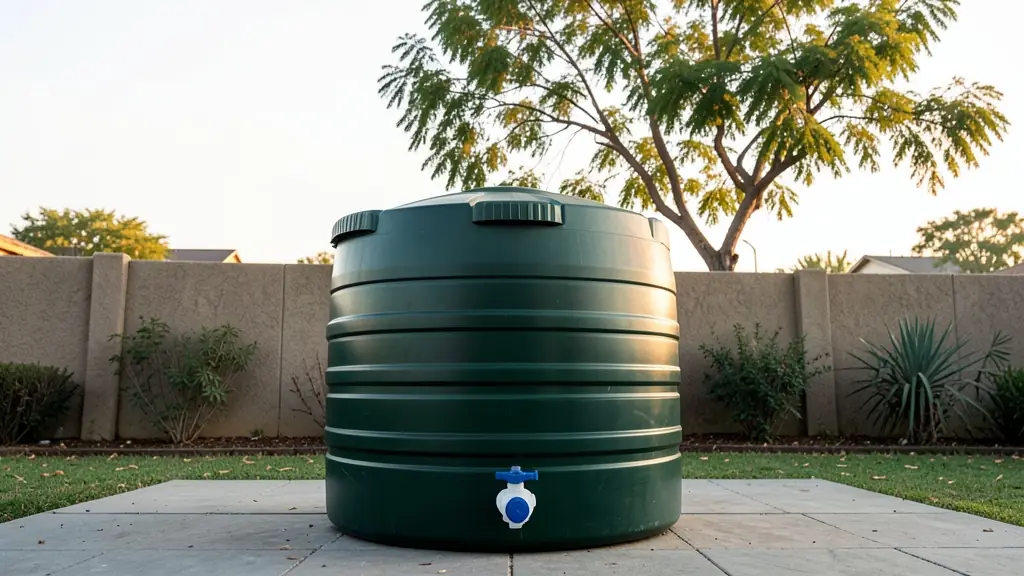
A plastic water tank is what most South Africans picture when they think of storage: the round green tank that many people simply call by a brand name. Underneath the colour, they differ more than the yard display suggests. The resin, the wall thickness, the inner layer and the fittings decide whether a tank lasts fifteen summers in full sun or splits at the outlet in its third year.
Price guideA farm and hardware co-op lists vertical plastic tanks at about R1,935 for 1,000 L, R2,435 for 2,500 L and R5,503 for 5,000 L, VAT included, and a DIY retailer lists 10,000 L tanks at R17,099 to R22,398A rough guide from published South African prices. The area, the term, the grade, what is included and VAT all move it.
How a polyethylene tank is made
Good tanks are rotomoulded: powdered polyethylene, often LLDPE, is tumbled inside a heated mould so the wall forms in one piece without joins. UV stabilisers in the outer layer stop the sun making the plastic brittle. Many makers add a lighter inner layer that is food grade, which is what you want for drinking water. A heavier tank of the same litres usually has a thicker wall, so ask the weight when you compare.
Colour, light and algae
Green, grey, beige and black keep light out, so algae cannot grow. A white or translucent tank, or one with a clear sight band, will go green inside in a sunny yard within a season. Pick the colour for the garden if you like, but never pick a tank you can see the water through.
Fittings to check before you pay
- An inlet at the top, often with a tank screen against leaves and mosquitoes.
- An outlet near the bottom with a bulkhead fitting, not just a threaded hole.
- An overflow sized to match the inlet, piped away from the walls.
- A lid that screws or clips tight, so children and insects stay out.
- A tap, or a ball valve for the pump line.
Ask which fittings are included in the price; some arrive bare.
What voids the warranty
Most claims fail on the base. A tank on uneven soil, on a stand smaller than its footprint or on a slab with a lip will bulge and crack, and the maker will say so. A heavy pipe hanging off the outlet without support also cracks the fitting. Use a level slab or a rated stand, work out what the full tank presses on it with the tank weight calculator, read the warranty, and keep the invoice.
Who asks for this
- Homeowners and tenants
- A round green or grey tank beside the house for outages or garden rain.
- Complexes, estates and landlords
- Matched plastic tanks per block, colour chosen to suit the body corporate rules.
- Builders and plumbers
- Standard polyethylene tanks with bulkhead fittings ordered with the plumbing materials.
- Shops, restaurants and offices
- A food grade tank behind a restaurant or shop with a pump to the kitchen.
- Farms, plots and lodges
- Dark plastic tanks at the borehole or on a koppie feeding troughs by gravity.
- Factories, mines and plants
- Polyethylene tanks for wash water and non drinking process water on a site.
- Schools, clinics and municipalities
- Food grade tanks at schools and clinics, filled from the main for outages.
- Events, sites and relief
- Plastic tanks on trailers or pallets at a venue, emptied and moved after.
Frequently asked questions
How long does a plastic tank last in the sun?
A well made UV stabilised tank often lasts well beyond its warranty period. Cheap tanks with thin walls fade, go chalky and turn brittle sooner, especially in the northern provinces where the sun is fierce.
Is a small water tank worth buying?
Yes, for a single job: a 500 L or 1,000 L tank on a downpipe waters a small garden, and a small tank on a stand gives a cottage a reserve. For a family through an outage, see water tank sizes.
How do I keep the water clean?
Keep the lid shut, screen the inlet, clear the gutters and drain the sludge now and then. When it starts to smell, book water tank cleaning.
What happens to an old plastic tank?
Polyethylene can be recycled. Some dealers take old tanks back when they deliver a new one, and plastic recyclers collect them; ask before the delivery truck leaves.