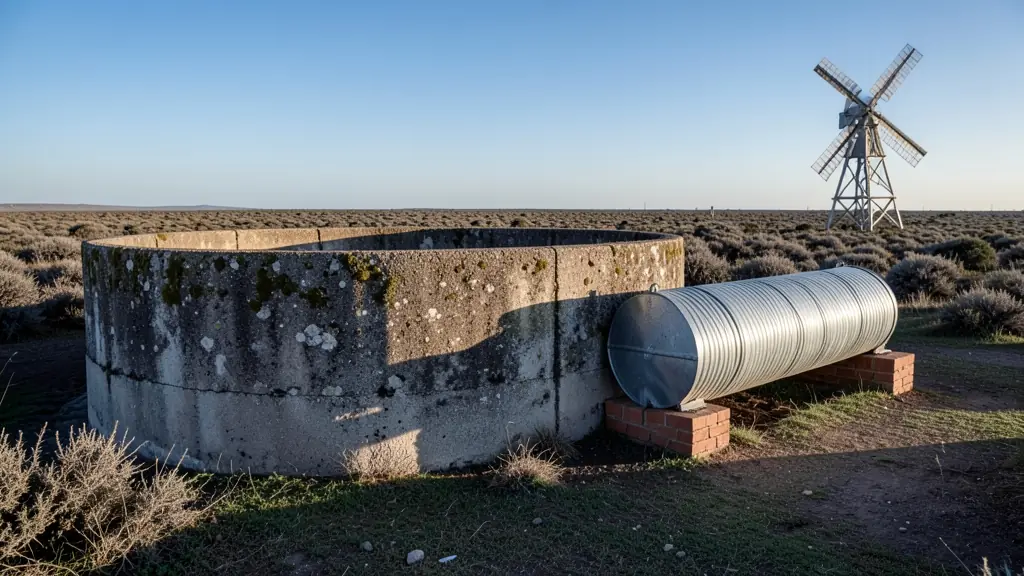
A tank volume calculator answers the question a faded label or an old reservoir cannot: how much does this thing hold? It helps with tanks you inherited with a house, concrete and brick reservoirs on farms, square header tanks in a roof and fuel or water tanks lying on their side. Compare the answer with the water tank sizes you can buy new.
Measure the inside
A tank's wall takes up room, so measure inside where you can, or take the outside and subtract the wall twice. For a round tank you need the diameter across the middle and the height to the overflow, not to the lid: water never rises above the overflow. Ribbed plastic tanks taper and bulge, so a tape round the middle divided by 3.14 gives a better diameter than a guess across the top. Type in metres, or switch to mm if your tape reads that way.
The three shapes
A round tank standing up holds 3.14 x radius x radius x height. A square or rectangular tank is length x width x height. A round tank lying on its side is the hard one: the water's width changes with the depth, so half the height does hold half the litres but a quarter of the height holds far less than a quarter. The tool works out the curved part properly. Each cubic metre is 1,000 L, or 1 kL, the unit on a municipal bill.
Worked example: a round tank 1.8 m across and 2.2 m high holds about 5,600 L full, which is why it is sold as a 5,000 L tank once the space above the overflow is left out.
How much is in it now
Push a clean stick or a weighted tape down through the inlet to the bottom and read the wet line. Put that depth in and the tool gives the litres in the tank and the share of the full volume. Doing this every morning for a week tells you what the house really uses, and is a cheap way to decide whether a water level sensor is worth fitting.
Underground and built tanks
For a brick or concrete reservoir, or a tank under the paving, measure from the manhole with a torch and a tape, never by climbing in: a closed tank can hold bad air. The same sums apply. If the answer is for a new tank, see underground water tanks and steel water tanks for what is built to size.
Frequently asked questions
How many litres in a cubic metre?
1,000 L. A cubic metre is also 1 kL, the unit your municipality bills in.
Why is my 5,000 L tank bigger than 5,000 L?
The sold size is usually the usable volume up to the outlet or overflow. The shell, measured to the lid, holds more.
How do I measure a tank lying on its side?
Measure the inside diameter, the length and the water depth from the bottom. Pick the lying shape in the tool; it handles the curve.
Can you send someone to measure my tank?
We do no site visits ourselves. Send a request and tank dealers, installers or tank cleaners near you can quote, and some will come out to measure.
Read more
More tools
- Water tank size calculatorPeople, litres a day, days to cover and the garden in: the litres to store, a tank combination and how long a tank lasts out
- Rainwater harvesting calculatorRoof area, roof type and your town's rainfall in: the litres a year and a month off the roof, the wettest month and a tank size out
- Water usage calculatorShowers, baths, flushes, laundry, dishes, the hose and the people in: litres a day and a month, the biggest uses and the monthly bill out
- Pump size calculatorTaps open at once, the height to the top tap, the pipe run and the pressure wanted in: the flow, the total head and a pump kW band out
- Water pressure calculatorHow high the tank stands above the tap, on a stand or up a hill, in: the pressure at the tap in bar and kPa and the height for the pressure you want out
- Tank fill time calculatorThe tank's litres and a hose, borehole, pump or mains flow, or the daily use, in: the hours to fill it and the days a full tank lasts out
- Tank weight calculatorThe tank's litres, its empty weight and the size of the base in: the full weight in kg and tonnes and the load on each m² of the base out