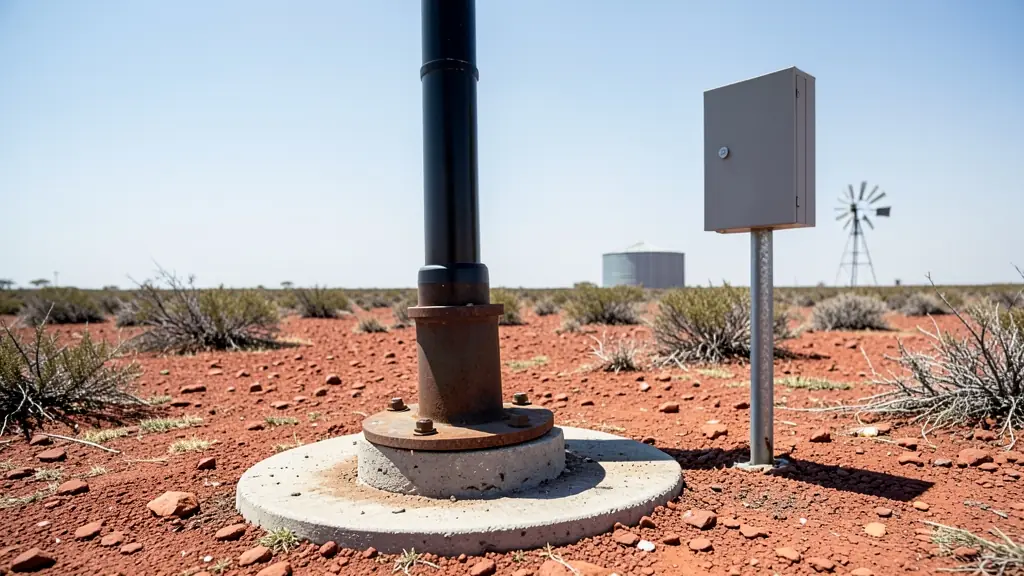
A borehole pump hangs far down the casing, often 40 to 120 m below the cap, and pushes water up the rising main to a tank or the house. Choosing one is not about the biggest motor in the pump shop: it depends on the width of the hole, how deep the water sits, how high the tank stands and, above all, how much the borehole can give an hour. Get those four numbers before you ask for a price.
Price guideA 230 V submersible borehole pump with motor and control box costs about R2,921 for 0.25 kW to R6,585 for 2.2 kW, VAT included, before the pipe, cable and installationA rough guide from published South African prices. The area, the term, the grade, what is included and VAT all move it.
The four numbers that size a pump for a borehole
- Bore diameter: most household holes take a 4 inch submersible; wider holes take 6 inch pumps with more flow.
- Depth to water and pump depth: the driller's log shows the static level and how far it drops while pumping. The pump sits below that drop, with a safe gap above the bottom so it does not suck silt.
- Head to the tank: the lift from the water level to the top of the tank, plus friction in a long pipe run. Use the pump size calculator for a first figure.
- The yield: litres an hour the hole gives in the yield test. A pump that draws more than that empties the hole.
Multistage submersibles, the control box and dry running
A submersible borehole pump is a stack of small impellers (multistage) on a sealed motor. More stages give more head, not more flow. Up top sits the control box with the starter, the protection and, on a good install, dry run protection that stops the motor when the water drops below the pump. Without it, a pump running all night on an empty hole burns out, and the motor can cost as much as the rest of the job. A float switch in the tank stops it when the tank is full.
Rising main, cable, three phase and theft
The rising main is HDPE pipe on most homes and steel on deep farm holes, with a safety rope and the drop cable strapped alongside. Farms with long runs often use three phase motors; houses run single phase. Pump wiring and the supply to the control box belong with someone qualified for that side of it, never a DIY job. Copper cable and pumps are stolen from remote holes, so a locked cap and a cage over the control box are worth the money.
Borehole pump price: what changes it
Pumps are priced by kW, stages and bore size, then the installation adds the rising main and cable per metre, the control box, the cap and the labour to lower it. A deep hole doubles the pipe and cable bill. New holes start at borehole drilling; a pump that stopped belongs under borehole repairs.
Who asks for this
- Homeowners and tenants
- A suburban borehole topping up the garden tank with a small submersible through the dry months.
- Complexes, estates and landlords
- One borehole pump feeding an estate's irrigation tank so the gardens skip municipal water.
- Builders and plumbers
- A new plot with a fresh hole that needs the pump, rising main and cap fitted.
- Shops, restaurants and offices
- A car wash or nursery drawing borehole water to a tank for daily washing and watering.
- Farms, plots and lodges
- Deep submersibles filling reservoirs and troughs for cattle across a spread of camps.
- Factories, mines and plants
- Large 6 inch pumps supplying process or dust water to a plant or quarry.
- Schools, clinics and municipalities
- A school or clinic borehole with a pump and control box that must be locked.
- Events, sites and relief
- A venue on a farm pumping borehole water to tanks before a weekend function.
Frequently asked questions
Can I use any submersible borehole pump in my hole?
No. It must fit the casing with room to spare, deliver the head your tank needs and stay below the yield. A pump shop sizes it from the driller's log, so send that with your request.
Why did my borehole pump burn out after a few months?
The usual causes are dry running when the water level dropped, a pump set too shallow, or no protection in the control box. Ask the installer to check the setting depth and fit dry run protection.
How do pumps come out of the borehole for repair?
The crew lifts the rising main by hand or with a tripod and winch, length by length. Steel columns and deep pumps need a pulling rig, which is part of the call out cost.
Do you sell or install borehole pumps?
No. Borehole installers and pump specialists near you get the details you send us, then each one prices the job for you with its own warranty.