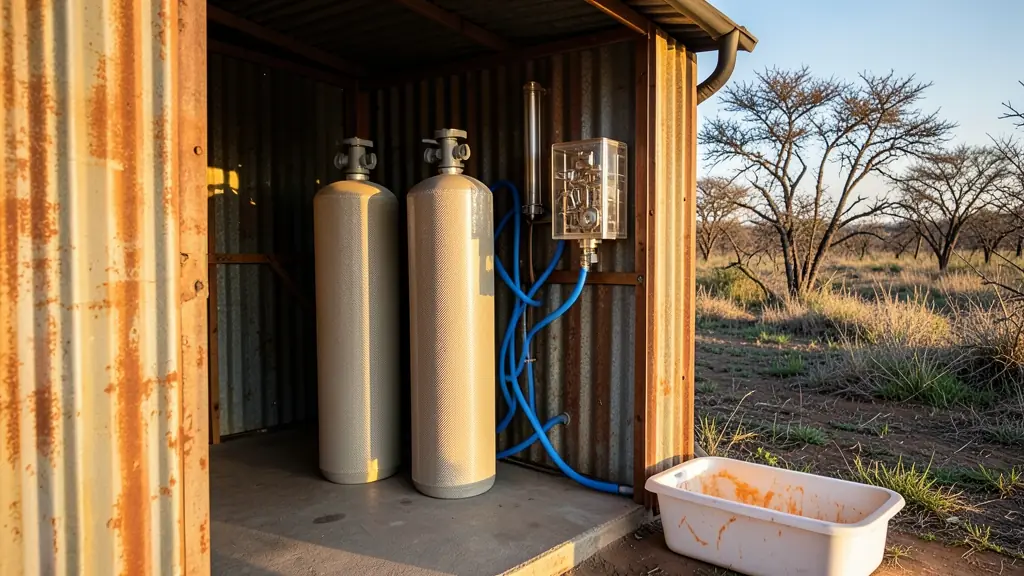
A water filter for a borehole is rarely one filter. Borehole water can carry iron that stains basins orange, manganese that leaves black marks, hardness that scales the geyser, sand that wears the pump, nitrates from old kraals and bacteria from a badly sealed casing. A lodge in the Waterberg and a smallholding outside Pretoria may need quite different treatment, so the order never changes: test the water first, then build the train to match the result.
Price guideAn iron and manganese filter vessel with media costs about R4,944 to R14,895 on special, by size and manual or automatic backwash, and a complete borehole and tank filter system about R18,500A rough guide from published South African prices. The area, the term, the grade, what is included and VAT all move it.
Read the signs, then test
The basin and your nose give the first clues:
| What you see | Likely cause |
|---|---|
| Orange or brown stains, water that clouds after standing | Iron |
| Black or dark grey marks in the toilet bowl | Manganese |
| White scale in the kettle and on shower heads | Hardness |
| Rotten egg smell, worst from the hot tap | Hydrogen sulphide |
| Grit in the tap aerators | Sand or silt |
Nitrates and bacteria give no sign at all. Take a sample in the lab's own clean bottle, from the borehole before any filter, and ask for a full analysis against SANS 241. That report drives everything that follows.
The treatment train for borehole water
- Sediment filter or a spin down screen to catch sand, coarse first and then finer.
- Iron filter with oxidising media that turns dissolved iron and manganese into particles and traps them; some need air injection or chlorine dosing ahead.
- Softener (ion exchange) where the hardness is high.
- Carbon for smell and taste.
- UV steriliser last, on clear water, to kill bacteria.
For drinking water from a salty or high nitrate borehole, a reverse osmosis unit at the kitchen tap finishes the job. Not every borehole needs every stage; the lab report decides.
Backwash, space and power
Iron filters and softeners clean themselves by backwashing: a valve on top reverses the flow every few days and flushes the trapped rust to drain. That needs a drain or soak away that can take a few hundred litres at a time, a pump with enough flow for the backwash, and a plug point for the valve. The classic mistake is an iron filter without backwash, really a big cartridge that clogs within a month and gets thrown away. Plan a dry, shaded spot near the tank with room to service the vessels, check the flow with the pump size calculator, and ask whoever fitted your borehole pump what it delivers.
Borehole water purification systems: upkeep
- Top up the salt in a softener before it runs out.
- Change sediment and carbon cartridges, often every few months on borehole water.
- Replace the UV lamp about once a year and clean its quartz sleeve, since an iron film blocks the light.
- Renew the iron filter media every few years, as the supplier advises.
- Retest the water once a year, and after floods or new drilling nearby.
Who asks for this
- Homeowners and tenants
- Orange stains gone from the basins and the geyser saved from scale on a plot.
- Complexes, estates and landlords
- One treatment room for an estate borehole feeding dozens of homes and gardens.
- Builders and plumbers
- A slab, a drain and a plug point left for the treatment train on a new build.
- Shops, restaurants and offices
- Clean borehole water for a guest kitchen, a car wash or a laundry.
- Farms, plots and lodges
- Lodges, farmhouses and dairy sheds turning iron rich or hard borehole water usable.
- Factories, mines and plants
- Pre treatment of borehole water for boilers, cooling towers and process lines.
- Schools, clinics and municipalities
- Schools and clinics on boreholes needing safe water tested against SANS 241.
- Events, sites and relief
- A mobile filter and UV unit at a camp or site that draws from a borehole.
Frequently asked questions
Do I need a bore hole water filter if the water looks clear?
Clear water can still carry nitrates, bacteria or too much fluoride. Looks say nothing about safety; a lab test does. Many farms use clear borehole water untreated for the garden and the stock, and treat only what goes to the kitchen.
Will a filter fix the water from a new borehole straight away?
New holes often pump cloudy water and silt for the first days. Let the driller finish the yield test and run the hole until it clears, then test. Filtering drilling silt only clogs new cartridges. See borehole drilling.
Can one system treat the whole house?
Yes. A point of entry system sits between the borehole tank and the house and treats every tap. It costs more and uses more salt and backwash water than treating the kitchen tap alone, so size it to real use and ask whether the garden line can bypass it.
Who quotes for borehole water treatment?
Water treatment companies and borehole service firms that work in your area; we supply nothing ourselves. Send the lab report or describe the stains and smell, plus the borehole flow and where the equipment can stand.
Related topics
Work it out first
- Water tank size calculatorPeople, litres a day, days to cover and the garden in: the litres to store, a tank combination and how long a tank lasts out
- Rainwater harvesting calculatorRoof area, roof type and your town's rainfall in: the litres a year and a month off the roof, the wettest month and a tank size out
- Tank volume calculatorA round, square or lying tank's size and the water depth in: the litres it holds full, the litres in it now and the kL out