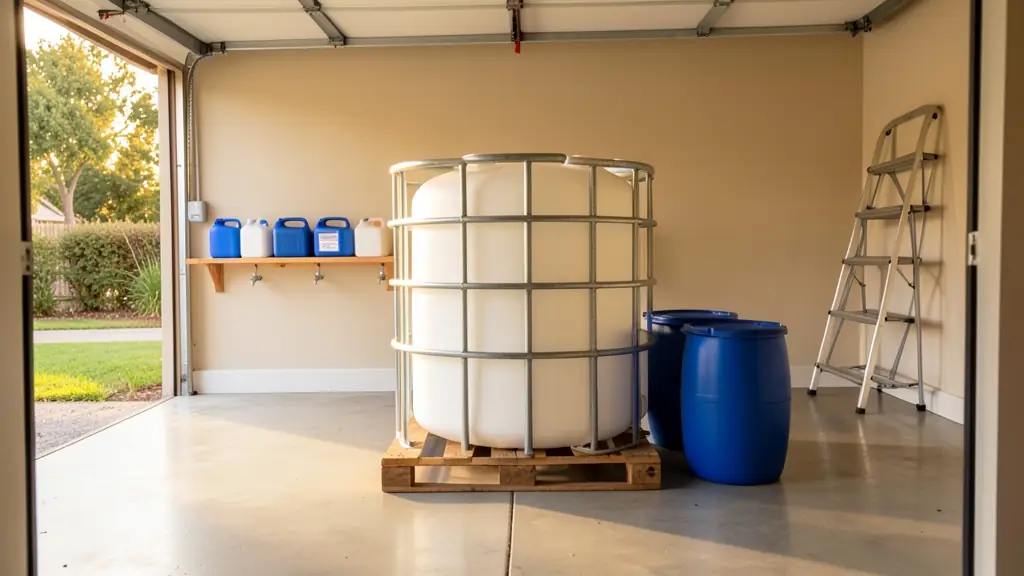
Water storage containers are the small end of storage: a few jerry cans in the garage, a drum at the back door, an IBC on a building site. They need no plumbing and no base, so they suit tenants, campers, 4x4 trips and anyone caught short by a three day outage. The catch is that stored water goes stale and some containers are not safe for drinking. Here is how to pick, fill and look after them.
Price guideAbout R390 to R490 for a 15 L or 25 L water jerry can, R552 for a 90 L drum, R1,104 for a 210 L drum and R2,250 to R3,000 for a new food grade 1,000 L IBCA rough guide from published South African prices. The area, the term, the grade, what is included and VAT all move it.
Which container for which job
- Jerry cans and 20 to 25 L containers: easy to carry when full, often with a tap. Good for drinking water at home, in the bakkie or at camp.
- Stackable bottles: flat sided so they pack in a cupboard or a 4x4 drawer.
- Drums (210 L): plastic drums with a screw lid for a garden, a site or a backup supply, moved empty and filled where they stand.
- IBC tanks: about 1,000 L in a steel cage on a pallet, moved with a forklift. Handy on farms and sites, or as a cheap step up before a water tank.
Is it safe for drinking water?
Buy containers sold as food grade for water, or new ones. A second hand IBC or drum is only fit for drinking water if it held food, such as juice or syrup, and you can see it was cleaned. Never use one that held chemicals, oil, fuel or pesticide for drinking or cooking water, however well it is washed: the plastic soaks some of it up. Ask the seller what was in it and treat an unclear answer as a no.
Keeping stored water fresh
Keep containers out of the sun, which warms the water and grows algae in thin or clear plastic. Fill from a clean tap, close the lid tightly and write the date somewhere on the shelf. Empty and refill every few months, using the old water on the garden. To clean one, scrub it with a small amount of unscented household bleach, following the label's guidance for treating water, then rinse it out well. If you are not sure of the source, purification tablets or boiling make water safer; read water purification systems.
How much to keep for an outage
About 25 L a person a day is a floor for drinking, cooking, washing and flushing a toilet with a bucket; most families use far more. A family of four for three days needs at least 300 L, which is a drum and a few jerry cans. Work out your own number on the water tank size calculator. For longer outages, a backup water system with a pump is easier than carrying cans.
Who asks for this
- Homeowners and tenants
- A few jerry cans and a drum in the garage for when the taps run dry.
- Complexes, estates and landlords
- Containers tenants can keep in a flat where no tank is allowed.
- Builders and plumbers
- An IBC on site for mixing, cleaning tools and dust control.
- Shops, restaurants and offices
- Drums of clean water so a salon or café can keep open through an outage.
- Farms, plots and lodges
- IBCs on a trailer to carry water to stock in a far camp.
- Factories, mines and plants
- Drums and IBCs of clean water for workshop wash stations and canteens.
- Schools, clinics and municipalities
- Drinking water containers for a clinic, school or relief point in an outage.
- Events, sites and relief
- Jerry cans and IBCs for hand washing and drinking at a camp or festival.
Frequently asked questions
What is the best 20 litre water container?
One made of food grade plastic, with a wide enough opening to clean, a lid that seals and a tap that does not drip. Darker or opaque plastic keeps the light out.
Can I use an IBC tank for drinking water?
Only a new one or one that held food, cleaned properly. Never an ex chemical IBC. Even then, treat or test the water if you are not sure of where it came from.
How long can water be stored in containers?
Clean tap water in a sealed food grade container keeps for months if it is cool and dark. Swap it every few months so you never rely on old water.
Do you sell water storage cans?
No. Hardware stores and container suppliers who cover your town read your list of cans, drums or IBCs and reply with their own prices.
Related topics
Work it out first
- Water tank size calculatorPeople, litres a day, days to cover and the garden in: the litres to store, a tank combination and how long a tank lasts out
- Rainwater harvesting calculatorRoof area, roof type and your town's rainfall in: the litres a year and a month off the roof, the wettest month and a tank size out
- Tank volume calculatorA round, square or lying tank's size and the water depth in: the litres it holds full, the litres in it now and the kL out