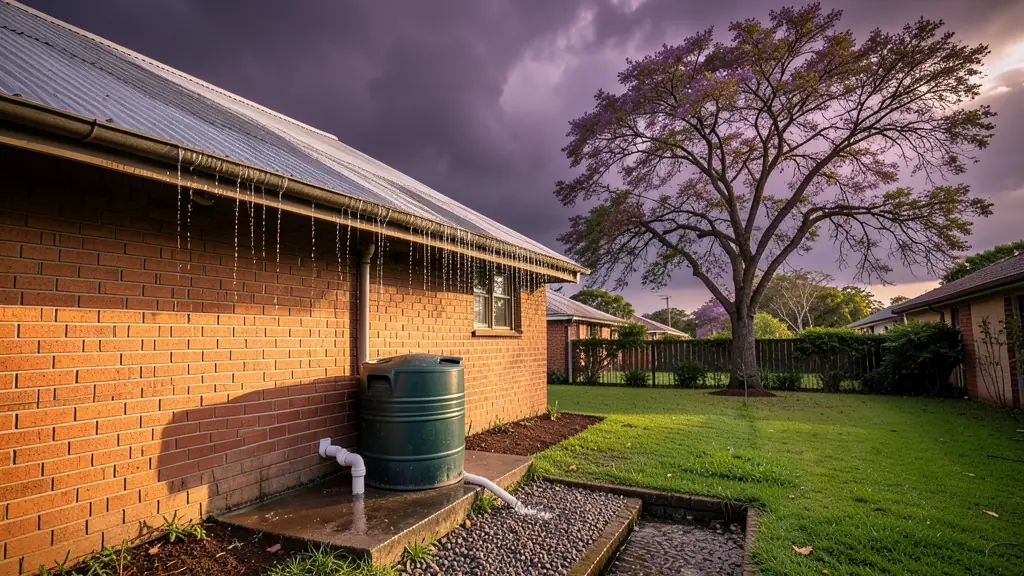
Rainwater harvesting means catching what falls on your roof and keeping it in a tank for the garden, the toilets and the washing machine. The sums are kind: 1 mm of rain on 1 m² of roof gives 1 L, so a 200 m² roof in a 20 mm Highveld thunderstorm can send about 3,200 L to the downpipes. Whether you keep it depends on the gutters, the screens, the tank size and when your rain falls in the year.
Price guideA cost guide puts a 1,000 L rain tank job at about R3,500 to R6,000, a 5,000 L system with a pump and filter at about R17,000 to R28,500 and a 10,000 L system at about R40,000 to R70,000, or about R3.40 to R7 a litre of storageA rough guide from published South African prices. The area, the term, the grade, what is included and VAT all move it.
How much rain a roof gives
Multiply the roof's plan area (the footprint, not the slope) by the rain in millimetres, then take about 80% for a metal or tiled roof, less for a rough or flat one. The first flush of every storm is worth losing anyway, since it carries the dust and bird droppings.
When the rain falls matters as much as how much. Most of the interior gets its rain in summer, roughly October to March, then dries out for months, so a tank there fills in December and runs low by August. The Western Cape gets winter rain, and the southern Cape coast gets rain all year round, so a smaller tank turns over more often. Put your roof and town into the rainwater harvesting calculator for litres a month.
Parts of a rainwater harvesting system in South Africa
- Gutters and downpipes with the right fall, so the whole roof reaches the tank.
- A leaf catcher or screened rain head on the downpipe.
- A first flush diverter, a pipe that fills with the dirtiest water before the rest flows on.
- The rain water tank, dark coloured, with a mosquito proof lid and a screened inlet.
- An overflow led away from the foundations and the neighbour's wall.
- A pump, because a tank at ground level gives almost no pressure.
Sizing the tank to catch the storms
A tank that is too small spills most of a summer storm; one that is too big sits half empty for years. Take a Pretoria gardener with a 200 m² roof: a 25 mm storm sends about 4,000 L to the tank, so a 5,000 L tank catches nearly all of it, and two linked tanks keep the garden going further into autumn. In winter rainfall areas, size for the dry gaps between cold fronts. Compare common sizes on water tank sizes, and remember each 1,000 L of water weighs about a tonne, so the tank needs a level slab.
Using rainwater in the house
Toilets and the washing machine are the easiest indoor uses, because they do not need drinking quality. That still means a pump, a separate pipe run and a clean split from the municipal supply: a plumber fits it, with a non-return valve guarding the main against backflow, and issues a certificate. Many municipalities want rainwater tanks that connect to the house registered, so ask yours. Drinking rainwater needs filtering, a UV steriliser and a test first; see water purification systems.
Who asks for this
- Homeowners and tenants
- A tank on the main downpipe to keep the garden green between summer storms.
- Complexes, estates and landlords
- Rain off a clubhouse or block roof stored for common gardens and washing bays.
- Builders and plumbers
- Gutters, downpipes and a tank base designed into a new house before plastering.
- Shops, restaurants and offices
- Roof water from a warehouse or a car wash used for washing and toilets.
- Farms, plots and lodges
- Shed and house roofs filling tanks for stock, dairies and homesteads off the mains.
- Factories, mines and plants
- Large factory roofs feeding steel reservoirs for washdown and process water.
- Schools, clinics and municipalities
- School and clinic roofs feeding tanks for toilets, food gardens and handwashing.
- Events, sites and relief
- A hall or barn roof at a country venue topping up tanks before the season.
Frequently asked questions
Is a rain water tank worth it in a summer rainfall area?
It can help, if you size it honestly. It fills fast in the thunderstorm months and carries the garden between storms, then runs dry in a long winter. Many households add a mains top up through a float valve so the same tank doubles as storage for outages.
Do I need a first flush diverter?
Not strictly, but it keeps a lot of dust, leaves and droppings out of the tank, so the water smells less and the tank needs cleaning less often. Empty it and check the small drain hole after the first storms of the season.
Can I drink harvested rainwater?
Not straight from the tank. Roofs gather droppings, dust and sometimes a dead bird in the gutter. For drinking, filter it, run it through a UV steriliser and have it tested against SANS 241.
Does waterstorage.co.za install rainwater systems?
No. We pass your request to tank dealers, gutter installers and plumbers near you, and they quote you. Give the roof area, the roof type, the tank size you have in mind and whether the water must reach the house.
Related topics
Work it out first
- Rainwater harvesting calculatorRoof area, roof type and your town's rainfall in: the litres a year and a month off the roof, the wettest month and a tank size out
- Water usage calculatorShowers, baths, flushes, laundry, dishes, the hose and the people in: litres a day and a month, the biggest uses and the monthly bill out